

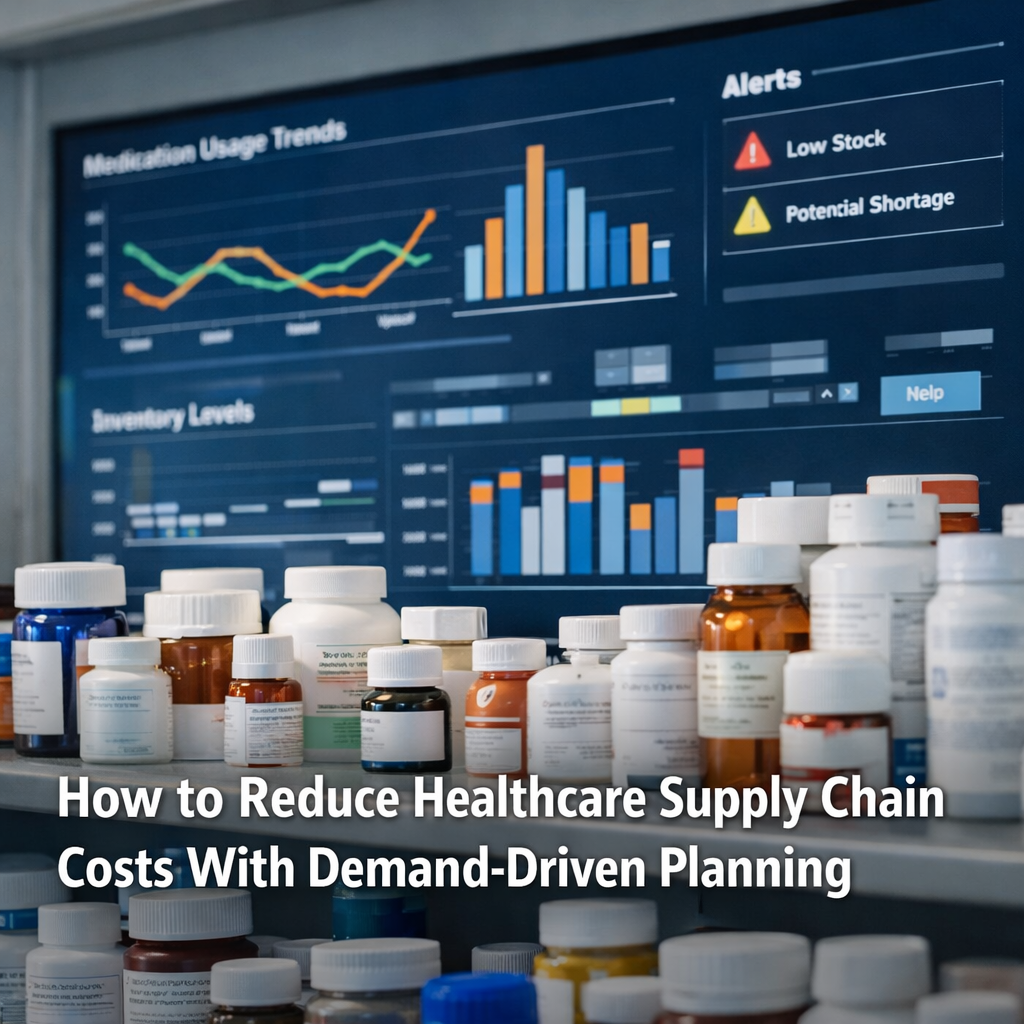
Pharmacy leaders face rising pressure to manage drug costs, control pharmacy spend, and maintain access to drugs without compromising safety, quality care, or medication adherence. Traditional cost-saving strategies often focus on short-term reductions that unintentionally increase risk, leading to stockouts, waste, and higher downstream healthcare costs.
This article explains how demand-driven planning supports sustainable cost-saving approaches for pharmacy and supply chain teams. You will learn how real-time demand intelligence helps reduce waste, optimize medication costs, support formulary decisions, and address drug costs proactively, before disruption may impact clinical outcomes or access.
The rising cost pressures facing healthcare supply chains
Health systems operate in a complex environment where rising costs for medications, especially specialty drugs, intersect with flat or declining reimbursement. Pharmacy benefit structures, PBM contract dynamics, and evolving insurance coverage further complicate cost control.
Recent research shows that hospitals across the U.S. spent roughly 20 million hours managing a range of drug shortages, which translates to nearly $900 million annually in labor costs.
These pressures reflect broader market dynamics, including changes in drug prices, average wholesale price (AWP) benchmarks, and rebate structures negotiated between manufacturers, PBMs, and insurers.
How pharmacy inefficiencies increase drug costs
How waste, expirations, and inefficiencies drive unnecessary spend
Expired pharmaceutical products represent direct financial loss. With medication costs representing a 9.4% increase year over year, waste becomes a significant driver of health care costs. When pharmacy teams order based on past patterns rather than current needs, they accumulate stock that sits unused until it must be discarded.
This cycle reinforces itself. Ordering extra inventory to avoid shortages ties up storage space and increases expiration risk, which prompts even larger orders.
Without automation, pharmacy staff struggle to track hundreds of SKUs, including brand name, generic medications, and biosimilar options. These inefficiencies directly affect the ability to manage costs effectively.
The financial impact of poor and misaligned pharmacy inventory
When pharmacy inventory levels do not match actual usage, health systems pay twice and incur costs associated with:
- Carrying excess inventory
- Emergency sourcing from a wholesaler at a premium
- Lost leverage in supplier negotiations
This challenge increases when Medicare reimbursement covers just 83 cents for every dollar spent by hospitals. Capital tied up in unused inventory cannot be reinvested in care services or assistance programs that reduce out-of-pocket costs for beneficiaries.
Staff time spent chasing down missing medications, adjusting stock levels, and managing vendor issues adds hidden labor costs. These operational burdens stem from the same root cause: pharmacy teams cannot optimize what they cannot clearly see.
Why cost reduction efforts often conflict with care quality goals
Pharmacy leaders often worry that cutting costs will compromise medication availability. This concern is valid when cost reduction relies on arbitrary cuts rather than evidence-based decisions. A Government Accountability Office (GAO) report found that 22 percent of respondents in active cancer treatment were affected by drug shortages, underscoring the real consequences when supply disruptions occur.
When stockouts occur, healthcare providers seek therapeutic alternatives. These substitutions may be unfamiliar, require different dosing protocols, or introduce unnecessary complexity into care. Clinicians naturally resist formulary changes when those changes appear driven purely by cost rather than clinical appropriateness. Building alignment requires showing that cost control and quality care can advance together through better planning.
Why traditional pharmacy cost control approaches fall short
Legacy approaches depend on lagging information, broad averages, and reactive responses that often create unintended consequences.
Why blanket cost-cutting measures can increase clinical risk
Across-the-board inventory reductions or formulary restrictions may lower expenses temporarily but often increase clinical risk. When certain medications are unavailable, clinicians must substitute therapies, which may impact medication adherence, require additional counseling, or introduce complexity into care delivery.
Shortages may also trigger compliance challenges related to prior authorization, cost-sharing, and diversion monitoring, further increasing operational burden for the pharmacist and care teams.
Manual reviews and lagging data
Managing pharmacy costs using historical averages and manual analysis limits insight. A medication treating high blood pressure may show stable trends overall but still experience short-term demand spikes. Manual reviews cannot surface these patterns quickly enough to support proactive decision-making.
Pharmacy teams need intelligence that arrives in time to act, not reports that document what already happened. Real-time visibility creates space for proactive decisions rather than reactive corrections.
Demand-driven planning replaces lagging reports with valuable insights derived from claims data, consumption signals, and real-time alerts—allowing teams to optimize inventory and control spending.
Hidden costs created by reactive purchasing and emergency sourcing
When shortages occur unexpectedly, expedited orders become necessary. These purchases carry premium prices for expedited shipping and small quantities from secondary suppliers. The instinct to over-order after a shortage often leads to excess inventory that eventually expires. Proactive shortage intelligence breaks this cycle by providing advance warning before supply disruptions occur.
What demand-driven planning looks like in practice
Demand-driven planning uses current demand signals to guide purchasing, replenishment, and sourcing decisions. This multifaceted approach supports both financial sustainability and care.
Using real demand signals to guide purchasing and replenishment
Real demand signals reflect what is actually happening in your facility today, not what happened on average last year. These signals include:
- Patient administration data
- Emerging shortage alerts
- Consumption patterns across departments
Technology plays a central role in capturing and interpreting these signals at scale. Automated systems track utilization continuously and flag deviations that warrant attention. Drug shortage management tools can surface early warning signals, giving teams time to secure alternative sources or adjust par levels before a shortage affects care.
Demand-driven planning is enabled by pharmacy-focused data and analytics platforms that transform utilization data into predictive insight and operational action. Tools that monitor contract performance and maximize purchasing value also help pharmacy teams continuously assess purchases against negotiated terms, automatically flag misaligned buys, and quantify cost-saving opportunities.
Segmenting predictable versus variable demand
Not all medications behave the same way. Demand varies widely based on clinical use and individual needs:
- Specialty medications such as chemotherapy agents or seasonal therapies fluctuate with patient census and treatment protocols.
- Generic drug options, including common antibiotics and maintenance therapies, typically follow stable usage patterns that support optimized reorder points and bulk purchasing.
Treating both categories the same increases the risk of waste or shortages. Demand-driven planning supports segmentation, allowing differentiated strategies for certain specialty products versus high-volume therapies, improving cost-effectiveness.
Supporting smarter inventory decisions without increasing staff workload
Pharmacy teams already carry heavy operational burdens. Any new approach must reduce complexity rather than add to it.
Automation through tools like a Supply Advisor helps by flagging medications approaching expiration, identifying slow-moving inventory, and recommending reorder quantities based on current demand. With this, staff can then focus attention where it matters most. This shift allows teams to spend less time managing inventory exceptions and more time on other clinical priorities.
How demand-driven planning supports pharmacy cost reduction strategies
Better planning directly reduces costs while protecting care quality. By aligning inventory with real demand, health systems can:
Reduce waste and expirations through better demand alignment
Accurate forecasting prevents over-ordering, which leads to expired inventory. When purchasing aligns with actual consumption, fewer products sit unused past their shelf life.
Visibility into upcoming expirations through the use of supply advisor software allows teams to prioritize older stock or redistribute products across facilities. These adjustments happen before waste occurs.
Lower carrying costs while maintaining medication availability
Carrying costs include capital tied up in inventory, storage space, insurance, and the risk of disuse. Right-sizing inventory levels based on real demand frees resources without creating gaps.
The key here is maintaining appropriate safety stock for critical medications while reducing excess for predictable items. This is where pharmacy procurement software can help teams find this balance by connecting usage data to purchasing decisions.
Improve pharmacy cost control without compromising care
Effective pharmacy cost control does not require sacrificing medication availability. When teams can anticipate shortages and adjust proactively, they maintain access to essential therapies while avoiding premium drug prices. People benefit when they receive the medications they need without interruption or unfamiliar substitutions. Clinicians benefit when formulary decisions reflect both clinical appropriateness and operational sustainability.
Create sustainable pharmacy cost control without compromising care
Sustainable cost management requires more than one-time savings initiatives. A multifaceted and value-based approach enables long-term improvement.
Shift from short-term savings to long-term operational efficiency
Delaying orders or reducing pharmacy safety stock may produce immediate savings. However, these approaches increase exposure to supply disruptions and often cost more over time. Investments in cost-effective planning capabilities yield returns that accumulate with each purchasing cycle. Small improvements in waste reduction, inventory turnover, and sourcing leverage add up across hundreds of medications.
Empower pharmacy and supply chain leaders with better insights
Clear signals, not more data, allow pharmacy and supply chain leaders to act confidently. When insight connects directly to execution, teams can optimize purchasing, improve formulary alignment, and maintain access without compromising safety.
Build a resilient, cost-effective healthcare supply chain model
Resilience means maintaining both medication availability and cost control even when supply chains face disruption. Demand-driven intelligence informs purchasing decisions, while trusted pharmaceutical partners provide backup options when shortages occur. Health systems that invest in these capabilities position themselves to navigate future challenges with greater confidence.
Quva supports health systems across the full lifecycle of medication risk by combining proactive intelligence with operational execution. Brightstream helps teams anticipate shortages earlier, while 503B-compliant ready-to-administer pharmaceuticals reduce compounding burden and maintain continuity when supply disruptions occur.
By operating at the intersection of healthcare SaaS, regulatory-grade manufacturing, and clinical accountability, Quva helps hospitals and health systems achieve pharmacy cost control without compromising safety. When intelligence leads to action, cost reduction becomes sustainable rather than reactive.
Sources:
- Vizient. New Vizient survey finds drug shortages cost hospitals nearly $900M annually in labor expenses. https://www.vizientinc.com/newsroom/news-releases/2025/new-vizient-survey-finds-drug-shortages-cost-hospitals-nearly-900m-annually-in-labor-expenses
- American Journal of Health-System Pharmacy. Impact of connected dispensing technology with advanced analytics in a multicenter health system. https://academic.oup.com/ajhp/article/81/23/e760/7714569
- American Hospital Association. Costs of Caring. https://www.aha.org/costsofcaring
- U.S. Government Accountability Office. DRUG SHORTAGES: HHS Should Implement a Mechanism to Coordinate Its Activities. https://files.gao.gov/reports/GAO-25-107110/
- American Society of Health-System Pharmacists. Drug Shortages Statistics. https://www.ashp.org/drug%20shortages/shortage%20resources/drug%20shortages%20statistics
