

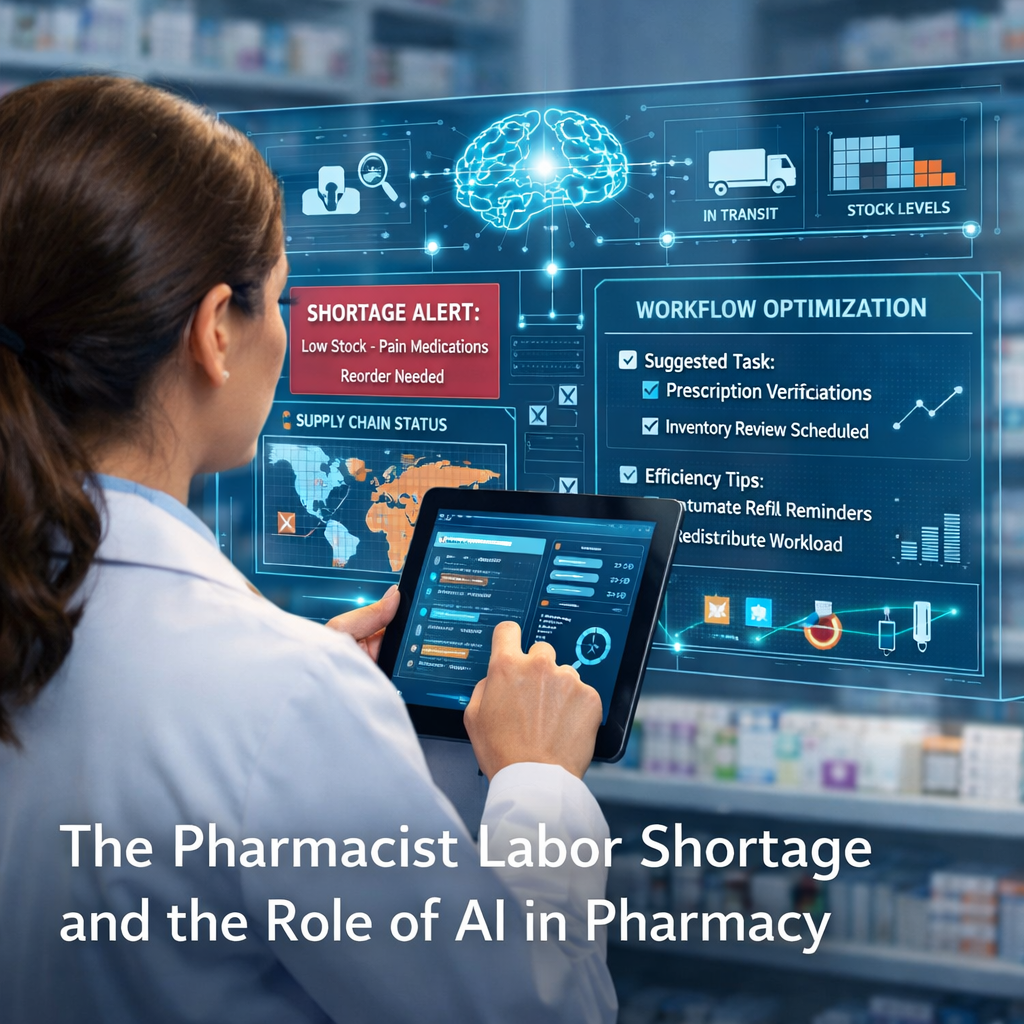
Healthcare organizations across the country are facing a growing pharmacist labor shortage. At the same time, drug shortages continue to increase in frequency and complexity. Together, these pressures create operational strain, heighten risk, and challenge care continuity.
As workloads expand and supply chains become more volatile, traditional management approaches are no longer sufficient. This is where AI in pharmacy and broader innovation in AI in health systems begin to play a meaningful role.
Advanced analytics and intelligent platforms can help pharmacy leaders move from reactive crisis management to proactive shortage mitigation, reducing risk while supporting overextended teams.
Understanding the Pharmacist Labor Shortage and Drug Supply Challenges
The pharmacist labor shortage and ongoing supply disruptions are interconnected. Fewer pharmacists must manage growing operational demands, including complex inventory oversight, regulatory documentation, and shortage response.
How staffing shortages strain pharmacy operations and decision-making
When staffing levels drop, pharmacists take on expanded responsibilities beyond clinical oversight. They monitor inventory, track shortage communications, evaluate alternatives, coordinate with prescribers, and manage documentation.
This expanded workload introduces several risks:
- Slower response to emerging shortages
- Increased reliance on manual tracking
- Reduced time for strategic planning
- Higher likelihood of pharmacist burnout
Operational decisions that once involved collaborative review may become rushed, increasing variability across sites.
The growing complexity of managing drug shortages at scale
Drug shortages now affect hundreds of products annually, often with little warning. Causes range from manufacturing delays to quality concerns and raw material constraints.
Large health systems must manage inventory across multiple sites with different utilization patterns and service line demands. Leaders must also account for therapeutic alternatives and contractual supply limitations, which significantly increases operational complexity, especially when multiple shortages occur at the same time.
Clinical and operational risks when supply disruptions go unmanaged
When shortages are not addressed proactively, organizations often resort to last-minute substitutions that disrupt workflows and increase documentation requirements. These rapid adjustments can create inconsistencies in therapeutic selection and administration practices.
Without structured oversight, unmanaged supply disruptions increase variability in care delivery and elevate the risk of medication errors, particularly in environments already strained by staffing shortages.
Why Drug Shortages Are Difficult to Anticipate and Manage
Shortages are rarely simple or isolated events. They develop gradually but become visible only when the inventory is nearly depleted.
Limited visibility into inventory, usage, and external supply signals
Many pharmacy operations lack unified visibility across real-time inventory levels, utilization trends, open purchase orders, and external supply alerts. Because systems often operate independently, identifying early warning signs becomes difficult.
Without integrated data, forecasting typically relies on historical averages rather than dynamic usage and supply conditions. This reactive approach limits the ability to anticipate emerging shortages before inventory reaches critical levels. In multi-site systems, the challenge becomes even more pronounced, as each facility may operate with slightly different data structures or reporting timelines. Without consolidated insight, leaders cannot easily distinguish between normal demand fluctuation and early-stage shortage risk.
Manual monitoring and fragmented shortage communications
Shortage notifications may arrive through manufacturer updates, wholesaler alerts, industry bulletins, and informal peer communications. Tracking these multiple channels manually requires significant time and attention. When teams are overstretched, important signals can be delayed or overlooked, reducing the opportunity for proactive planning and mitigation. In many organizations, there is no standardized process for aggregating and validating these communications. Pharmacists may need to cross-reference alerts against internal inventory reports, supplier portals, and historical usage trends to assess relevance. This manual reconciliation slows response time and increases the likelihood that subtle but important warning signs are missed.
The burden placed on already understaffed pharmacy teams
Traditional shortage management often begins only after an alert is issued or inventory levels visibly decline. At that point, teams must rapidly secure remaining supplies, identify substitutes, and update ordering systems. Understaffed teams must simultaneously manage clinical responsibilities while coordinating procurement, documentation, and communication efforts. Over time, repeated reactive cycles contribute to staff fatigue and make it increasingly difficult to implement long-term, preventive strategies.
The Limits of Traditional Drug Shortage Management
Most organizations still rely on reactive processes designed for less volatile environments.
Reactive responses driven by alerts and last-minute substitutions
Most traditional shortage workflows begin only after an official alert is issued or inventory levels drop to visibly concerning thresholds. By the time action is taken, available options may already be limited, forcing teams into urgent decision-making. Last-minute substitutions often require rapid evaluation of dosing differences, formulation changes, and operational implications. Over time, repeated reactive cycles create instability, making it difficult for pharmacy teams to move beyond constant crisis management.
Challenges coordinating responses across departments and sites
In larger health systems, shortage management requires coordination across multiple departments, service lines, and facilities. Without centralized visibility and standardized processes, each site may develop its own mitigation strategy. This decentralized response can lead to inconsistent substitution protocols, uneven allocation of limited inventory, and duplicated efforts across teams. Leadership may struggle to obtain a consolidated view of system-wide impact, delaying strategic decisions.
Increased risk of variability in care and medication errors
When substitutions are implemented quickly, variability becomes difficult to avoid. Differences in concentration, preparation requirements, or administration workflows can introduce complexity into already busy care environments. Under staffing pressure, even small variations increase the potential for documentation inconsistencies and medication errors. As a result, risk mitigation often depends heavily on individual vigilance rather than structured intelligence
How Analytics Support Smarter Drug Shortage Management
Modern analytics platforms enable a shift from reaction to anticipation. This is where AI in pharmacy becomes transformative.
Anticipating shortages using utilization and supply trend data
AI-driven models can analyze:
- Real-time utilization rates
- Days-on-hand inventory
- Supplier lead times
- Historical shortage patterns
By identifying deviations from expected patterns, organizations can detect emerging risks earlier. Instead of discovering a shortage at depletion, leaders gain advance notice. More broadly, AI in the healthcare industry uses similar predictive modeling to support upstream supply forecasting, increasing transparency across the entire ecosystem.
Identifying alternative therapies and mitigation strategies earlier
Advanced systems can map therapeutic equivalencies and evaluate:
- Clinical appropriateness
- Inventory availability
- Utilization impact
This enables pharmacy leaders to evaluate mitigation strategies before shortages reach critical levels.
Reducing manual workload for pharmacy teams
Automation reduces time for pharmacy teams spent on:
- Data reconciliation
- Manual inventory checks
- Alert monitoring
- Report generation
By surfacing prioritized insights rather than raw data, AI platforms support decision-making without adding new administrative burdens.
Key Insights That Help Navigate Drug Shortages More Effectively
Early signals that indicate emerging shortage risk
Leading indicators often appear subtle at first, making them easy to dismiss without the right monitoring infrastructure. However, when analyzed collectively, small deviations in supply or demand can signal meaningful risk weeks before inventory depletion becomes visible. Key leading indicators may include:
- Sudden increases in daily utilization
- Supplier fill-rate declines
- Backorder frequency
- Regional demand spikes
AI tools can monitor these continuously, flagging risks before they escalate. When these signals are surfaced early and contextualized against historical trends, pharmacy leaders gain valuable time to implement mitigation strategies instead of reacting under pressure.
Visibility into usage patterns that accelerate depletion
Shortages are not driven by supply constraints alone; internal consumption dynamics often accelerate depletion faster than expected. Without granular visibility, organizations may misinterpret rapid drawdown as an external disruption rather than a localized usage shift. Granular analytics reveal:
- Department-level usage
- Provider-specific ordering trends
- Seasonal variation
By connecting these insights to forecasting models, pharmacy teams can identify abnormal consumption patterns early and intervene before inventory reaches critical thresholds.
Data-driven prioritization of limited supply
When inventory becomes constrained, allocation decisions must balance clinical urgency, operational feasibility, and long-term sustainability. Without structured guidance, prioritization may rely on subjective judgment or inconsistent communication across departments. When supply is constrained, objective prioritization becomes critical. Analytics can support allocation decisions by assessing:
- Clinical urgency
- Historical demand
- Alternative availability
Building a More Resilient Approach to Drug Shortages
Shifting from crisis response to proactive planning
A resilient approach begins with moving beyond crisis-driven workflows. Instead of waiting for inventory to reach critical lows, pharmacy leaders can use predictive indicators and utilization trend analysis to identify risk earlier. Proactive planning includes scenario modeling, standardized mitigation pathways, and cross-functional communication protocols that activate before shortages escalate.
By embedding forecasting and early warning systems into routine operations, organizations reduce variability and maintain greater control during periods of supply instability.
Supporting pharmacists with decision intelligence, not more tasks
Technology should extend pharmacist expertise rather than increase administrative burden. When shortage management relies on manual monitoring and spreadsheet tracking, staffing shortages are compounded rather than relieved.
Decision intelligence platforms powered by AI in pharmacy centralize data, prioritize actionable alerts, and provide structured guidance for evaluating alternatives. This allows pharmacists to focus on clinical oversight and strategic coordination instead of reactive data reconciliation. Over time, intelligent systems help stabilize workloads while improving consistency in shortage response.
Protecting care continuity amid staffing and supply pressures
Care continuity depends on both stable inventory and sustainable staffing. When supply disruptions and labor shortages intersect, the risk of inconsistent substitutions and workflow disruption increases significantly.
A resilient strategy aligns predictive analytics, centralized visibility, and standardized mitigation processes to protect therapy availability across sites. More broadly, across the healthcare industry, similar AI-driven approaches enhance upstream supply forecasting and improve distribution transparency. Together, these capabilities promote continuity, reduce operational volatility, and build a more resilient pharmacy infrastructure.
Supporting Pharmacy Resilience with Quva
Drug shortages and workforce constraints place sustained pressure on pharmacy teams and the systems they support. When organizations have proactive visibility into emerging risks and coordinated tools to manage disruption, they can protect continuity and reduce operational strain.
At Quva, we exist to safeguard care by combining predictive intelligence with operational execution. Through the Quva Brightstream platform, we help healthcare organizations anticipate shortage risk, strengthen supply visibility, standardize mitigation strategies, and reduce manual workload across pharmacy operations.
By connecting AI-driven insight with practical solutions, Quva enables pharmacy leaders to move from reactive crisis management to a more resilient, data-informed model of care continuity.
Sources:
- American Society of Health-System Pharmacists. Drug Shortages Statistics. https://www.ashp.org/drug-shortages/shortage-resources/drug-shortages-statistics
- Becker’s Hospital Review. Pharmacy workforce shortages slowing growth. https://www.beckershospitalreview.com/pharmacy/pharmacy-workforce-shortages-slowing-growth/
- Pharmacy Times. Long-Lasting Drug Shortages Highlight Fragile Supply Chains and Systemic Market Pressures. https://www.pharmacytimes.com/view/long-lasting-drug-shortages-highlight-fragile-supply-chains-and-systemic-market-pressures
- Pharmaceutical Commerce. AI, Demand Sensing, and Integrated Data Systems in Pharmacy Shortage Forecasting. https://www.pharmaceuticalcommerce.com/view/ai-demand-sensing-integrated-data-systems-pharmacy-shortage-forecasting
